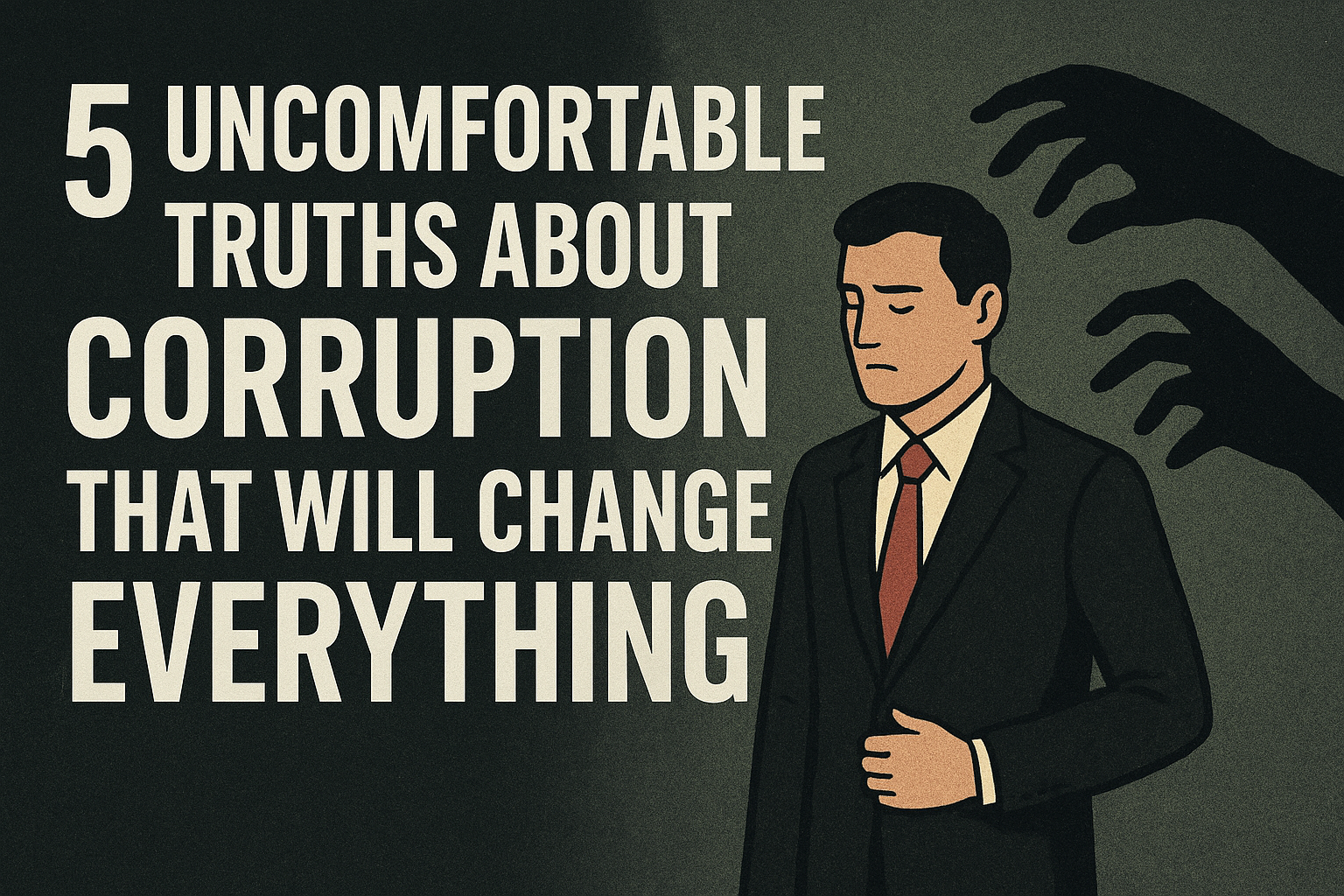
5 Uncomfortable Truths About Corruption That Will Change Everything
When we think of corruption, the image that usually comes to mind is almost cinematic: a politician accepting a briefcase full of money in a dark parking lot. It’s a simple, clear, and morally unambiguous scene. However, this view, while useful for movies, is a dangerous simplification of a much more complex, systemic, and often surprising reality. The truth about corruption is far more uncomfortable than a simple act of individual greed.
This article will reveal five insights, drawn from global governance research, that will challenge your understanding of what corruption is, why it persists so tenaciously, and how it actually affects all of us in ways we rarely consider. Prepare to shift your perspective.
- Corruption is not one problem, it is many (and it’s rarely just a bribe)
While in everyday language “corruption” is often equated with “bribery,” this view is drastically incomplete. Academic research shows that corruption is a multifaceted phenomenon—a multi-headed hydra. Treating it as a single problem is like trying to cure all diseases with a single medicine.
An innovative approach suggests that corruption manifests in different “syndromes” that depend on a country’s political and economic institutions. Understanding these syndromes is crucial, as each reveals a distinct pathology and, therefore, requires a different treatment. The four main syndromes are:
- Influence Markets: Typical of wealthy, well-institutionalized democracies. Here, political influence is traded legally as a commodity through campaign donations, lobbying, and the “revolving door.” While often legal, it distorts public policy and can limit economic competition.
- Elite Cartels: Common in newer or reforming democracies with moderately strong institutions. In this scenario, networks of political and economic elites collaborate to share the benefits of corruption, maintaining system stability and excluding competitors.
- Official Moguls: Develop in settings with very weak institutions. A few dominant elites monopolize power and resources, governing more by personal might than official authority, and using the state for their personal and client enrichment.
- Oligarchs-and-Clans: Also characteristic of very weak institutions, but here, instead of a monopoly, multiple power figures and their followers compete for wealth and power in an environment of widespread insecurity. In these cases, corruption is often directly linked to violence.
This truth is transformative because it radically changes the battlefield. Recognizing that we face not a single enemy, but an ecosystem of distinct problems, is the first step toward stopping the application of universal cures to specific diseases and starting to design reforms that truly work.
- The Fight Fails Because We Often Treat the Wrong Disease
The traditional anti-corruption approach is based on what is known as the “principal-agent” model. This model views corruption as a “bad apples” problem: dishonest individuals (the agents) who abuse their position for personal gain, betraying the trust of an honest public or superior (the principal). The solution, from this perspective, is simple: improve oversight and increase punishments to catch and deter corrupt individuals.
However, in countries with systemic corruption, the problem is not a few bad apples, but the “rotten barrel.” Corruption is not a deviation from the norm; it is the norm. It becomes what theorists call a “collective action problem.”
When everyone else is expected to be corrupt, the costs of acting with integrity are astronomically high for a single individual. If an official refuses a bribe, they not only lose extra income but can be viewed as a threat by colleagues and superiors, risking isolation or dismissal. If a citizen refuses to pay, they may never get the service they need. In these systems, there simply are no “principled principals” willing to enforce the rules, because they are often part of the system themselves.
Reforms based on the “bad apples” model fail because there is no one willing to implement them. Understanding this is crucial: it forces us to shift the focus from individual blame to institutional design, from prosecution to systemic prevention.
The reflection of an interviewee in a study on Uganda and Kenya perfectly captures this dilemma: “There is complacency. Everyone does it, so whether it is good or bad, everyone does it anyway. Am I the one who is going to change the world? That is the kind of thing you see in people’s behavior.”
- The World’s “Cleanest” Countries May Be the Biggest Accomplices in Global Corruption
Every year, Transparency International’s Corruption Perception Index (CPI) ranks countries according to the perceived level of public sector corruption. Countries like Denmark, Finland, and Switzerland usually top the list, projecting an image of near-perfect integrity. However, this image can be misleading.
When we compare the CPI with another indicator, the Financial Secrecy Index (FSI), a disturbing paradox emerges. The FSI measures how opaque a country’s financial system is and how large its role is in the global offshore economy. What it reveals is that many of the countries perceived as the “cleanest” are also among the biggest facilitators of financial secrecy worldwide.
What does this mean in practice? It means that while these countries may have very low levels of domestic bribery, their banking and legal systems offer safe havens for money stolen through corruption elsewhere in the world—often from the Global South—to be laundered and hidden. In effect, they act as the world’s laundromats, allowing corrupt elites from poorer nations to enjoy their illicit gains. The implication is transformative: the fight against corruption is not just a battle within the borders of “corrupt” countries, but one that must be waged in the financial centers of the “clean” countries that enable it.
- Measuring Corruption is More Art Than Science (and Our Most Famous Tools Are Flawed)
The fundamental challenge in measuring corruption is that, by its very nature, it is a secretive activity. Those who participate in it have every incentive to conceal it. For this reason, most of our most famous indicators do not measure corruption directly.
Tools like the Corruption Perception Index (CPI) are based, as the name suggests, on the perceptions of experts and businesspeople, not on objective data or direct experiences. While useful for raising awareness, these indices have serious limitations:
- Subjectivity: They reflect the opinions of a select group of people, not necessarily the reality on the ground.
- Lagging Indicators: Changes in scores often reflect corrections of past assessment errors rather than real, contemporary changes in corruption levels.
- “Non-Actionable”: A country may know its score is low, but the index offers no clear guidance on which specific policies it should implement to improve.
Faced with these limitations, alternative approaches have emerged that seek to measure corruption more directly and objectively:
- Experience Surveys: Instruments like the Global Corruption Barometer directly ask thousands of citizens if they or someone in their household has paid a bribe to access public services in the last year. This offers a more direct view of “everyday” corruption.
- Objective Data Indices: An example is the Public Integrity Index (PII), which is not based on perceptions, but on “hard” data about the institutional factors that control corruption. It measures variables such as judicial independence, budgetary transparency, press freedom, and the digitalization of citizen services (e-citizenship).
This shift in focus is transformative: it allows us to move from a simple country ranking to a precise diagnosis that can guide evidence-based policy reforms.
- In Extraordinary Circumstances, There Might Be “Good Bribery”
Bribery is almost universally condemned by all major religions and philosophical systems. It damages trust, perverts justice, and undermines institutions. The idea of a “good bribe” seems, at first glance, a moral contradiction. However, a historical case forces us to consider a profound ethical dilemma.
During the Holocaust, the German industrialist Oskar Schindler used his factory as a refuge for over a thousand Jewish workers, saving them from certain death in concentration camps. To achieve this, Schindler systematically and extravagantly paid bribes to Nazi officials and SS members.
From a purely legalistic perspective, his actions were corrupt. His bribes undermined the administrative system of the Third Reich, distorted war production, and violated the regime’s rules. However, today no one would consider his actions immoral. They are universally justified because they were used to prevent an immeasurably greater evil: genocide.
This is, of course, an extraordinary case and by no means a general justification for bribery. Its importance lies in what it teaches us: that in situations of “absolute evil,” moral rules can become terribly complex. The transformative lesson is not to justify bribery, but to recognize that ethics, in the abyss of absolute evil, demands we weigh real-world consequences above abstract rules. It forces us to ask not only if a rule was broken, but why it was broken and what was achieved by doing so.
Conclusion
Far from being a simple act of individual avarice, corruption is revealed as a complex systemic problem. It is not one disease, but many. Our fight against it often fails because we apply the wrong diagnosis. Our perceptions of who is “clean” and who is “complicit” may be fundamentally wrong, and the tools we use to measure the problem are imperfect. Even its seemingly absolute moral condemnation faces profound ethical dilemmas at the limits of human experience.
This leaves us with a fundamental question. Now that we see corruption not as a simple act of greed, but as a complex system of incentives and institutional failures, how does it change our responsibility—not just to point fingers at the corrupt, but to demand and build systems that make integrity the most rational option?
And that is exactly the approach we seek by implementing anti-bribery controls based on ISO 37001 standards and other state-of-the-art anti-corruption strategies in our consultancy work at Ir a ROE Latam.
We can help you tailor a compliance system that effectively reduces bribery and corruption risks, customized to your organization’s specific framework and context.
Contact us at online@roelatam.com
If you found this post interesting, perhaps you would like to explore these:
- ESG in Latin America 2025: Real Change or Just Rhetoric?
- FCPA and Anti-Terrorism Act: The New Crossroads of Compliance Risk in Latin America
- Regional Anti-Corruption Compliance Takes Center Stage in Latin America
- Strengthening Anti-Bribery Systems: ROE Latam Delivers ISO 37001 Internal Audit Training to CORSAIN El Salvador
- Internal Investigations: A Guide to Mitigating Corporate Risks and Ensuring Compliance
- Navigating Cartel and FTO Designations: Advanced Compliance Strategies for Global Businesses
- 2024 Corruption Perceptions Index (CPI): How Corruption Fuels the Climate Crisis
- The Essential Guide to KYC Regulations in Mexico: What Real Estate Professionals, Financial Institutions, and Buyers Must Know
- ISO 37001: Sistema de Gestión Antisoborno (SGAS)