Safeguarding Your Business: The Strategic Importance of AML Compliance in Mexico
1. Introduction: The Current Landscape of Anti-Money Laundering (AML) in Mexico
In the current Mexican regulatory environment, the implementation of an effective internal control system is not merely a bureaucratic requirement, but a fundamental pillar for corporate survival. Organizations across all sectors are vulnerable to being utilized as vehicles for money laundering (LA) and terrorist financing. To mitigate these threats, a robust framework is essential to protect a firm’s integrity, legal standing, and market reputation.
Under Mexican law, specifically the Federal Law for the Prevention and Identification of Operations with Resources of Illicit Origin (LFPIORPI), the effectiveness of these systems depends on a “Tone at the Top” approach. It is a specific legal responsibility of the Board of Directors to provide formal approval for the adoption and application of the internal control system, ensuring that compliance is integrated into the organization’s core strategy.
Key Perspective AML compliance is an non-delegable responsibility of the Board of Directors and High Management. Their active involvement in approving the system ensures that integrity and regulatory adherence are prioritized at every level of the organization, moving beyond a “compliance culture” toward a legally mandated oversight structure.
2. The COSO Framework: A Blueprint for AML Compliance
The COSO framework serves as the global gold standard for internal control, consisting of 17 principles distributed across five integrated components. For Mexican entities, this structure provides a technical roadmap to manage the complexities of AML risk:
- Control Environment: This is the foundation upon which all other components are built. It involves establishing a clear ethical tone through a Code of Conduct that explicitly prohibits illicit activities. A critical principle here is ensuring the AML compliance unit possesses the necessary authority, independence, and resources, including a Compliance Officer with direct, unfiltered access to the Board of Directors.
- Risk Assessment: Organizations must evaluate their exposure to money laundering by identifying Inherent Risks (threats present in the absence of controls) and Residual Risks (the exposure remaining after mitigation). This assessment must account for high-risk clients (Politically Exposed Persons – PEPs), international transfers, geographic risk zones, and modern distribution channels, such as digital banking and fintech platforms.
- Control Activities: These are the specific technical measures implemented to mitigate identified risks. An expert framework classifies these into three categories:
- Preventive Controls: Designed to stop illicit acts before they occur (e.g., robust KYC and identity verification).
- Detective Controls: Surveillance measures designed to identify “red flags” or facts when preventive controls are bypassed (e.g., transaction monitoring).
- Corrective Controls: Actions taken to remedy the effects of a materialized risk and investigate root causes.
- Information & Communication: Relevant information must be captured and communicated timely. This requires secure, confidential reporting channels (whistleblower boxes) backed by strict non-retaliation policies. Furthermore, specialized training is mandatory for personnel in high-risk roles to ensure they can identify evolving laundering typologies.
- Monitoring: The system must be dynamic. Continuous supervision through internal and external audits ensures the program adapts to new GAFI/FATF regulations and incorporates technological innovations, such as the use of Artificial Intelligence (AI) for the detection of unusual financial patterns.
3. Understanding the Risks of Non-Compliance
A weak AML framework leaves a business exposed to multidimensional threats that can lead to total operational failure:
- Reputational Risk: Severe damage to the organization’s public image, leading to a loss of trust among stakeholders and the potential loss of key clients.
- Integrity Risk: Compromising the ethical foundation of the company, often resulting from the misuse of corporate resources for illicit ends.
- Economic Risk: Financial devastation resulting from fraud, weak management, or the misappropriation of organizational funds.
- Operational Risk: Structural threats such as technological obsolescence and the inability to manage organizational growth or resources effectively.
4. Regulatory Thresholds: Vulnerable Activities under LFPIORPI
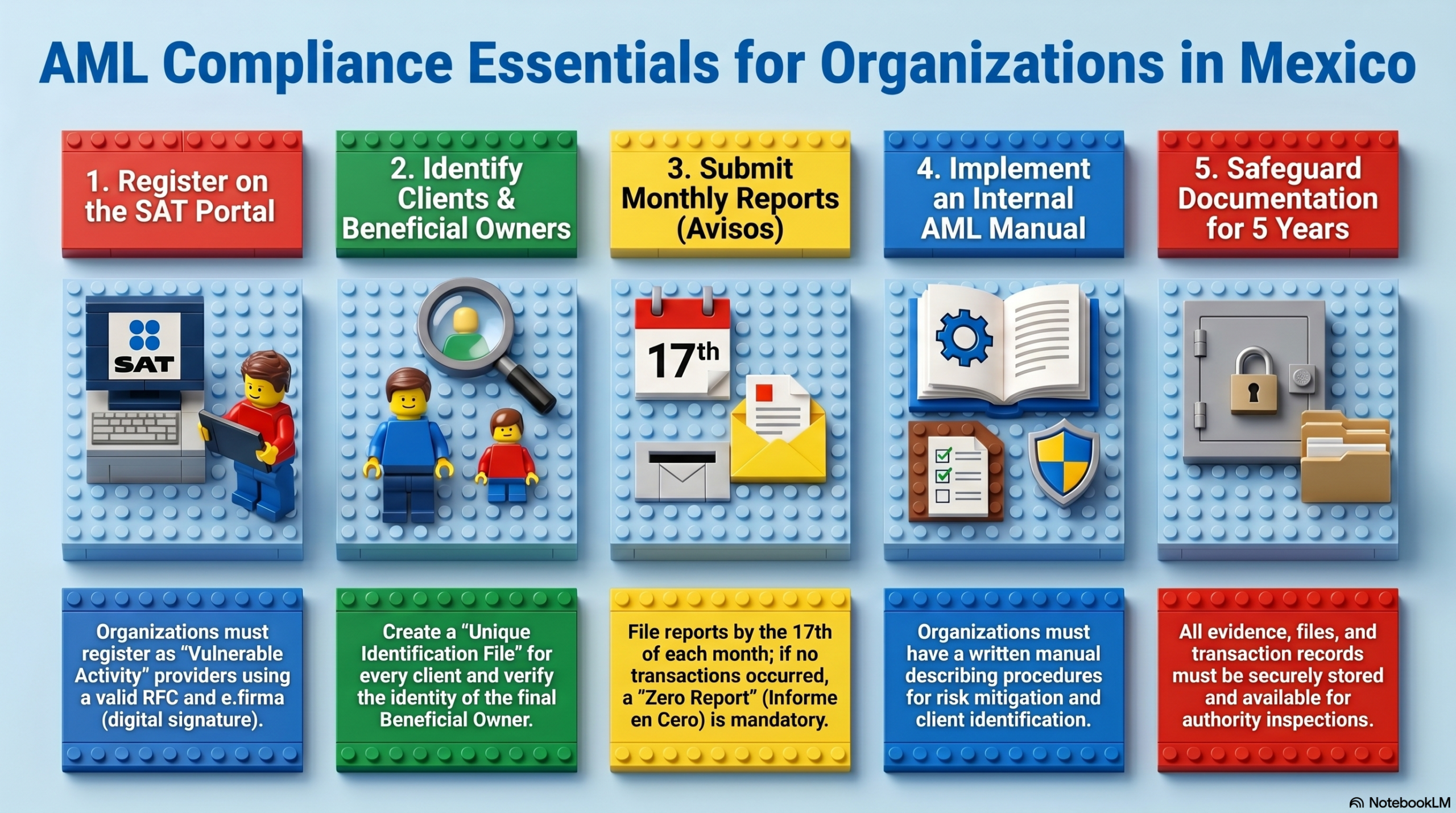
Under Article 17 of the LFPIORPI, certain “Vulnerable Activities” trigger mandatory identification and reporting (Avisos) to the SHCP. The following table details the thresholds applicable as of September 2025:
Activity Type | Identification Threshold (Pesos MXN) | Notice/Reporting Threshold (Pesos MXN) |
|---|---|---|
Casinos, Gambling, and Lotteries | $36,770.50 | $72,975.30 |
Real Estate (Construction and Development) | Always Mandatory | $907,948.50 |
Jewelry, Precious Metals, and Watches | $91,077.70 | $181,589.70 |
Professional Services (Asset/Account Management) | Always Mandatory | Only if acting in name/rep of client |
Virtual Assets (Cryptocurrencies) | Always Mandatory | $23,759.40 |
Nuance Note: For Professional Services (Fracción XI), the obligation to file a “Notice” (Aviso) is specifically triggered when the professional carries out financial operations in the name and on behalf of the client.
5. The Critical Role of the “Real Beneficial Owner” (Propietario Real)
In accordance with the SHCP Lineamientos (2019), identifying the “Real Beneficial Owner” is a core pillar of transparency. This refers to the physical person who ultimately exercises control over a legal entity or benefits from its transactions.
Criteria for Identifying Control
- Control by Ownership (The 25% Rule):
- Identification of any physical person who directly or indirectly holds 25% or more of the shareholding or capital stock.
- Control by Decision-Making/Other Means:
- The power to impose decisions in the General Shareholders’ Meeting or equivalent governing body.
- The ability to appoint or remove the majority of directors or managers.
- Maintaining rights to vote more than 50% of the capital stock.
- The capacity to direct the administration, strategy, or principal policies.
- Control by Position (Cargo):
- In cases where ownership is fragmented (below 25%), the entity must identify the individual occupying a high-level position (CEO, President, Treasurer) who directs daily operations.
6. Actionable Best Practices for Mexican Businesses
To align with SHCP (Mexican IRS) requirements and the COSO framework, businesses must adopt the following strategic actions:
- Empowered Compliance Officer: Appoint a specialist with sufficient authority and a direct reporting line to the Board to ensure independence.
- AI-Driven Monitoring: Leverage automated systems and AI to detect unusual transaction patterns that human oversight might miss.
- Precise Legal Reporting: Ensure all regulatory filings utilize correct legal terminology (e.g., “Avisos” for vulnerable activities) to avoid administrative sanctions.
- Regulatory Evolution: Maintain a system that updates automatically in response to new GAFI/FATF guidelines and SHCP mandates.
- Organized Documentation: Keep detailed, audit-ready records of KYC files and risk assessments to facilitate seamless regulatory inspections.
ROE Latam Takeaway In an era of unprecedented regulatory scrutiny, a robust AML framework is no longer an optional “best practice”—it is the only way to ensure business continuity in the Mexican market. By integrating the COSO components with strict adherence to SHCP guidelines, organizations transform a compliance burden into a competitive advantage, fostering trust and ensuring long-term institutional stability.
If you found this article interesting, perhaps you would like to check these:
- The Compliance Revolution: How AI and Blockchain are Redefining the Future of ISO 37001 and FCPA Enforcement
- Internal Investigations: A Guide to Mitigating Corporate Risks and Ensuring Compliance
- 6 Essential Requirements of the EU Whistleblowing Directive: A Compliance Guide for Organizations
- Portal de Prevención de Lavado de Dinero – SAT (Spanish)